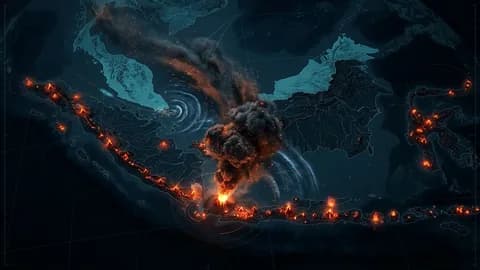
127 Active Volcanoes, Zero in Malaysia — But We Are Still Exposed
127 Active Volcanoes, Zero in Malaysia — But We Are Still Exposed
Malaysia has no active volcanoes.
Indonesia officially has 127.
At first glance, that looks like a very comfortable distinction for Malaysia.
Then Anak Krakatau erupts.
In early September 2026, volcanic ash from Anak Krakatau disrupted aviation around Jakarta, forcing airport closures and affecting hundreds of flights. Malaysian carriers were among those forced to cancel or reschedule services. Malaysia Airlines cancelled 12 Jakarta flights on September 6, while AirAsia also cancelled or rescheduled flights because of the ash hazard.
So Malaysia does not need a volcano of its own to experience the consequences of one.
That is the more interesting story.
This is not simply about Indonesia having a lot of volcanoes.
It is about how a geological hazard crosses borders without asking permission.
What actually happened in September 2026?
The current Anak Krakatau episode began with renewed activity in July 2026.
According to Indonesia's Geological Agency, Anak Krakatau returned to eruptive activity on 2 July 2026 after a prolonged quieter period. It remained at Level III — Siaga from that date.
Then, late on Friday 4 September 2026 (WIB, UTC+7), the volcano entered a phase of continuous eruption accompanied by rumbling sounds and persistent incandescent activity. The agency described the activity as resembling a lava-fountain phase and reported that the eruption continued into September 5. PVMBG's September 5 special report times the continuous phase from about 11:07pm local time, while BMKG's first aviation warning (SIGMET) followed the initial eruption at 23:23 WIB — the minute differs by milestone (eruption onset vs continuous-phase onset vs first warning), not by event.
By September 6, the consequences were no longer confined to the volcano itself.
Volcanic ash was detected around Jakarta and surrounding regions, and ash clouds reached altitudes reported as high as approximately 50,000 feet.
Reuters' September 6 daytime snapshot put the toll at 301 flights, including 58 international services; Bernama's same-day count was 209 flights and 22,798 passengers affected at Soekarno-Hatta. By Sunday evening, Reuters tallied 964 affected flights at Soekarno-Hatta alone and more than 1,500 flights with 170,000 passengers across eight airports, while the AP likewise reported eight airports closed and about 170,000 passengers affected. The figures differ because they measure different operational categories and time windows.
That distinction matters.
When reporting a fast-moving disaster, a single "number of flights affected" can become misleading very quickly.
Malaysia was affected too
Malaysia was not directly hit by lava, ashfall, or an eruption column.
But Malaysian aviation was affected.
Malaysia Airlines cancelled 12 flights between Kuala Lumpur and Jakarta on September 6 because volcanic activity was affecting operations at Jakarta's Soekarno-Hatta International Airport.
Batik Air Malaysia also cancelled flights, bringing the Malaysia Airlines and Batik Air total to 20 Malaysia–Jakarta flights for the day.
AirAsia separately announced that a number of flights to and from Jakarta had been cancelled or rescheduled, while selected other services were adjusted because their flight paths could be affected by volcanic ash.
This is an important distinction:
Malaysia was not experiencing a volcanic disaster.
Malaysia was experiencing the downstream effects of a volcanic disaster in Indonesia.
That is what transboundary risk looks like.
Why volcanic ash is such a big deal for aviation
Volcanic ash is not ordinary dust.
It contains tiny particles of fragmented volcanic rock and glass. At aircraft cruising altitude, those particles can enter jet engines, melt inside the hot sections, and potentially accumulate on turbine components.
Ash can also:
- damage engine components
- reduce visibility
- contaminate aircraft systems
- affect air-data sensors
- abrade cockpit windows
- create navigation and operational hazards
The most famous example is British Airways Flight 9 in 1982.
A Boeing 747 encountered a volcanic ash cloud over Indonesia after the eruption of Mount Galunggung.
All four engines temporarily lost thrust.
The aircraft eventually restarted its engines and landed safely, but the incident became one of aviation's defining lessons about volcanic ash.
The lesson was simple:
You do not need to fly over an erupting volcano to be in danger.
You only need to fly through its ash cloud.
That is why volcanic ash is treated as an aviation hazard rather than merely an environmental nuisance.
Why Indonesia has 127 active volcanoes
The usual answer is:
"Because Indonesia is on the Ring of Fire."
True.
But incomplete.
Indonesia sits within a complex zone of plate convergence where the Indo-Australian Plate is being subducted beneath the Sunda/Eurasian plate system along major parts of the Indonesian archipelago.
The basic process looks something like this:
             OCEANIC CRUST
        Indo-Australian Plate
                 ↓
                 ↓
        ───────────────────
             SUBDUCTION
        Sunda Trench / Arc
                 ↓
            fluids released
                 ↓
           mantle melting
                 ↑
                 ↑
              MAGMA
                 ↑
                 │
            VOLCANIC ARC
      Sumatra → Java → Bali
           → Nusa Tenggara
The descending slab carries water and other volatile components into the Earth's interior.
As it descends, those fluids are released into the mantle above it.
The addition of water lowers the melting temperature of mantle material.
Partial melting occurs.
Magma forms.
Some of that magma eventually rises through the crust and feeds volcanic systems.
That is the simplified version.
The actual Indonesian tectonic system is considerably more complicated because several plates, microplates, subduction zones, arcs, and collision zones interact across the archipelago.
That complexity is one reason Indonesia does not have one uniform "volcano system."
It has several interacting volcanic and tectonic environments.
127 does not mean 127 volcanoes erupting
This is an important clarification.
When Indonesian authorities say 127 active volcanoes, they are using an official geological classification.
It does not mean:
127 volcanoes are currently erupting.
Indonesia's Geological Agency breaks the 127 down into 77 Type A, 29 Type B and 21 Type C volcanoes, with 69 effectively monitored through its network of observation posts. PVMBG continuously monitors that subset through its observation-post network.
In fact, the official classification includes volcanoes with very different histories and levels of present-day activity.
So the number is best understood as:
127 volcanoes classified as active within Indonesia's volcanic monitoring framework.
Not:
127 volcanoes currently threatening to erupt.
That distinction matters when communicating risk.
Why Malaysia has no active volcanoes
Malaysia's geological position is different.
Most of Peninsular Malaysia lies away from the active Indonesian subduction arc.
Malaysia is largely situated on the relatively stable Sunda Plate region rather than directly above the main active volcanic arc responsible for the volcanoes of Sumatra and Java.
That is why Malaysia does not have an Indonesian-style chain of active stratovolcanoes.
Malaysia's National Risk Register (§3.8 Volcanic Activities) states explicitly that no active volcano is reported within Malaysia. It also warns against confusing Malaysian mud volcanoes with magmatic volcanoes.
But "no active volcano" does not mean "no volcanic history."
Sabah has volcanic history
Sabah is particularly interesting.
The region contains evidence of past volcanic activity, including volcanic rocks and old volcanic structures.
Mount Bombalai near Tawau is a well-known example.
But this is where terminology matters again.
An old volcanic cone is not an active volcano.
The National Risk Register (§3.8 Volcanic Activities) identifies Mount Bombalai as an approximately 27,000-year-old volcanic cone mountain remnant in Tawau, Sabah, that is no longer active.
So saying:
"Malaysia has no volcanoes"
is technically too broad.
A better statement is:
Malaysia has no currently active magmatic volcanoes.
Malaysia has geological evidence of ancient volcanic activity.
It simply does not have the kind of active volcanic systems currently found across Indonesia.
Malaysia is still exposed
This is the part that matters most.
A country does not need to contain a hazard source to be exposed to its consequences.
1. Aviation
This is the clearest example.
The September 2026 Anak Krakatau eruption affected flights between Indonesia and Malaysia.
The disruption was caused not by lava reaching Malaysia, but by the aviation system responding to dangerous ash conditions.
BMKG reported multiple volcanic-ash-related aviation warnings (18 SIGMETs by September 6) and satellite observations showing ash distribution across a wide area.
That is why volcanic ash is treated as an international aviation problem.
The ash does not care where one country's FIR ends and another begins.
2. Tsunami
Anak Krakatau has another reason for being taken seriously.
On 22 December 2018, a flank collapse of Anak Krakatau generated a tsunami in the Sunda Strait.
The disaster killed more than 400 people.
It was unusual because the tsunami was not primarily generated by a conventional large earthquake.
Instead, volcanic activity and the collapse of part of the volcano displaced seawater.
The September 2026 event did not produce a detected tsunami.
BMKG's multi-sensor monitoring reported no sea-level anomaly indicating a tsunami in the Sunda Strait as of 07:00 WIB on the morning of September 6.
That is an important distinction:
The volcano has tsunami history.
This eruption did not produce a detected tsunami.
We should not turn historical risk into a claim that every eruption will generate a tsunami.
3. Atmospheric effects
Very large volcanic eruptions can affect the atmosphere far beyond the immediate eruption zone.
Sulfur dioxide released high into the atmosphere can form sulfate aerosols that influence radiation balance and climate.
History gives us several examples.
The 1815 eruption of Tambora in Indonesia was enormous and contributed to the climatic anomalies associated with the Year Without a Summer in 1816.
These events are rare.
That is exactly why they should not be used to imply that every Indonesian eruption will cause climate disruption in Malaysia.
The correct lesson is simply:
Large volcanic eruptions can become regional or global atmospheric events.
4. Economic disruption
Then there is the less dramatic but more common effect:
money.
A cancelled flight can mean:
- missed meetings
- hotel extensions
- cargo delays
- missed connections
- tourism losses
- airline recovery costs
- supply-chain disruption
And aviation is only one part of the regional economy.
Indonesia and Malaysia are deeply connected through tourism, trade, manufacturing, logistics, education, labour mobility, and family travel.
A disruption in one country can quickly become an operational problem in another.
This is why borders are misleading
Imagine drawing a line around Malaysia.
Inside the line:
No active volcano.
Outside the line:
127 officially classified active volcanoes in Indonesia.
From a map perspective, that looks reassuring.
From a risk perspective, it is incomplete.
Hazards operate differently.
Political border
─────────────────────────────
        │
        │

Volcano ───────→ Ash ───────→ Aircraft
          wind              disruption
                                │
                                ↓
                         Malaysia

Volcano ───────→ tsunami ─────→ coastal areas

Volcano ───────→ atmosphere ──→ regional effects
The political border is real.
The hazard boundary is not.
The geopolitics of volcanic ash
An eruption such as Anak Krakatau can involve an entire chain of institutions.
In Indonesia:
- PVMBG monitors volcanic activity.
- Badan Geologi provides geological assessment.
- BMKG monitors atmospheric and tsunami conditions.
- AirNav Indonesia manages air navigation.
- BNPB coordinates disaster response.
Outside Indonesia:
- Darwin VAAC provides regional volcanic ash advisories.
- ICAO coordinates international aviation procedures.
- CAAM manages Malaysian civil aviation safety and airspace matters.
- Airlines make operational decisions based on available hazard information.
That is a regional system.
Not an Indonesian-only system.
And it illustrates something important about modern disaster management:
The country where a disaster starts is not necessarily the only country that has to manage its consequences.
ASEAN has a role too
This is where volcanic risk becomes an ASEAN issue.
The region already has institutions designed for cross-border disaster coordination.
The ASEAN Agreement on Disaster Management and Emergency Response (AADMER) provides the regional framework.
The AHA Centre supports coordination and information sharing during disasters.
Those mechanisms are valuable because hazards such as:
- floods
- haze
- earthquakes
- tsunamis
- volcanic eruptions
do not necessarily respect national borders.
But volcanic ash has a special characteristic.
It moves through the atmosphere.
That makes aviation coordination particularly time-sensitive.
An ash cloud can move across an international flight information region far faster than conventional diplomatic or administrative processes can react.
That is why international volcanic-ash monitoring and aviation coordination systems exist.
Why "Ring of Fire" is not enough
"Ring of Fire" is a useful phrase.
But it is not an explanation.
Indonesia's volcanic geography is the result of several interacting tectonic systems.
Among them are:
- the Sunda volcanic arc
- the Banda arc
- the Sangihe arc
- volcanic systems around Halmahera and northern Sulawesi
Each has different geological characteristics.
The result is an archipelago with an unusually high concentration of volcanic systems.
Indonesia's Geological Agency currently counts 127 active volcanoes — 77 Type A, 29 Type B and 21 Type C.
Malaysia sits outside that main active volcanic belt.
That is why our geological risk profile is different.
But different does not mean isolated.
What should Malaysians actually watch?
If you live in Malaysia, you do not need to monitor every volcano in Indonesia.
A few signals matter more.
PVMBG alert levels
Indonesia uses four volcanic activity levels:
Level I   Normal
Level II  Waspada
Level III Siaga
Level IV  Awas
These levels describe the activity and hazard conditions of individual volcanoes.
They should not be interpreted as a prediction that an eruption will definitely occur.
Volcanic Ash Advisories
For aviation, this is arguably more important than the volcano's headline status.
A volcano can be highly active without affecting Malaysian air routes.
Conversely, an ash cloud can create an aviation hazard even when the eruption itself is geographically distant.
Wind and atmospheric conditions
Ash follows atmospheric circulation.
The direction and altitude of the ash plume determine which areas and flight routes may be affected.
This is why the same volcano can produce very different regional impacts during different weather patterns.
Tsunami monitoring
For volcanoes near the sea, particularly around the Sunda Strait, tsunami monitoring remains important.
But again:
Volcanic activity does not automatically mean tsunami.
The September 2026 BMKG monitoring found no sea-level anomaly indicating a tsunami associated with the current Anak Krakatau sequence.
The bigger lesson
There is a common way of thinking about disasters:
Where is the disaster?
For transboundary hazards, the better question is:
Where can the consequences go?
The volcano may be in Indonesia.
The aircraft may be Malaysian.
The passengers may be Singaporean.
The cargo may be heading to Japan.
The destination airport may be somewhere else entirely.
The disruption is no longer neatly Indonesian.
That is how modern interconnected systems behave.
The uncomfortable truth
Indonesia has 127 officially classified active volcanoes because of its extraordinary tectonic setting.
Malaysia has no active volcanoes because we sit in a different geological position.
That gives Malaysia a significant advantage when it comes to direct volcanic hazards.
But it does not give us immunity.
Ash can enter aviation routes.
Tsunamis can cross seas.
Atmospheric effects can travel across borders.
Economic disruption can propagate through connected markets.
And a flight cancellation is enough to demonstrate the point.
The volcano does not have to be in Malaysia.
The risk only has to reach a system that Malaysia depends on.
Geology creates the hazard.
Wind and water move it.
Infrastructure transmits it.
And borders do very little to stop it.
Sources
- Indonesia Geological Agency — Anak Krakatau continuous eruption report, September 5, 2026
- BMKG — Monitoring the impact of the Anak Krakatau eruption, September 6, 2026
- BMKG — No sea-level anomaly / tsunami detected in Sunda Strait
- Reuters — Indonesia's Jakarta airport suspends flights due to Anak Krakatau ash
- AP — Indonesia cancels flights at Jakarta airport and others as Anak Krakatau erupts
- Malaysia Airlines — 12 Jakarta flights cancelled
- AirAsia — Flights impacted by Mount Anak Krakatau eruption
- Bernama — Malaysia Airlines and Batik Air cancel 20 Malaysia-Jakarta flights
- Malaysia National Risk Register — Volcanic Activities
- Indonesia Geological Agency — Indonesia's 127 active volcanoes
// author
Editor & Operator
Mohd Firdaus Abu Bakar (MrDodgerX) is an enterprise geospatial systems engineer in Malaysia and the editor behind hejes.my. He runs the briefing pipeline, curates and edits every draft, verifies each factual claim against primary sources, and presses the publish button — nothing ships without his review. He writes about AI, security and Malaysia's tech scene from a builder's perspective. Professional profile and code: the links below.
// sources //
fact-check verified · 09 SEPT 2026 · hejes-content-fact-check
- Anak Krakatau continuous eruption report, September 5, 2026Badan Geologi Indonesia · accessed 09 SEPT 2026
- BMKG monitoring the impact of the Anak Krakatau eruption, September 6, 2026BMKG · accessed 09 SEPT 2026
- BMKG multi-sensor monitoring: no sea-level anomaly in Sunda StraitBMKG · accessed 09 SEPT 2026
- Indonesia's Anak Krakatau eruption halts flights, schools, fishingReuters · accessed 09 SEPT 2026
- Indonesia cancels hundreds of flights as Anak Krakatau volcano eruptsAssociated Press · accessed 09 SEPT 2026
- Indonesia's Anak Krakatau eruption halts flights, schools, fishing (Sept 6 snapshot)Nikkei Asia (Reuters wire) · accessed 09 SEPT 2026
- Malaysia Airlines cancels 12 Jakarta flights after Anak Krakatau eruptionThe Star · accessed 09 SEPT 2026
- AirAsia flights impacted by the Mount Anak Krakatau volcanic eruptionAirAsia Newsroom · accessed 09 SEPT 2026
- Malaysia Airlines and Batik Air cancel 20 Malaysia-Jakarta flightsBernama · accessed 09 SEPT 2026
- National Risk Register — Volcanic Activities (§3.8)NADMA Malaysia · accessed 09 SEPT 2026
- Indonesia's 127 active volcanoesBadan Geologi Indonesia · accessed 09 SEPT 2026
- Anak Krakatau: Collapsed volcano's tsunami simulatedBBC News · accessed 09 SEPT 2026
- B742 en-route south-southeast of Jakarta 1982 (BA009 ash encounter)SKYbrary Aviation Safety · accessed 09 SEPT 2026
- Mount Tambora explosively erupts in 1815NOAA NESDIS · accessed 09 SEPT 2026
related //

Aeon Bank's RM1 billion reward glitch, explained
A customer saw RM1,000,315,879 land in his Aeon Bank account. Here is what the bank said, what the law says, and the guardrails a payout system needs.

CTOS Breach: When the Credit Agency Asks You to Reset Your Password
CTOS confirmed a limited subset of consumer data was accessed; password-reset notices are now reaching account holders. Here is what it means.

Tabung Haji Cyberattack: Depositors' Savings Safe, Services Restored
Tabung Haji suspended all services after a cyberattack, restored them within days and says savings are safe. What depositors should know and check.
// join the feed
one fresh insight per week. no spam, ever.
weekly digest. unsubscribe anytime.