
The 30-Day Form Behind Malaysia's AI Seizures
Customs seized RM49.5M of AI servers at KLIA. The offence was a missing 30-day form, and the directive's real gate is a Category 4 entry few read.
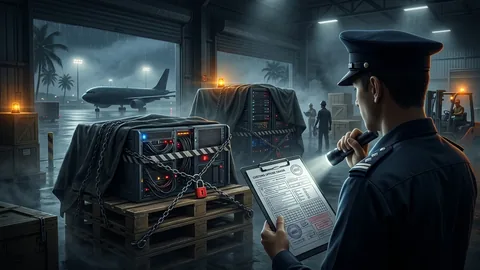
At about 11.30am on 15 October 2026, customs officers opened a shipment in a KLIA Free Commercial Zone warehouse and found 30 servers built around advanced AI accelerators. Declared value: RM45 million. With an estimated RM4.5 million in duties and taxes, the department put the seizure at RM49.5 million, roughly US$12.1 million.
That number leads every headline and is the least useful part of the story. Nothing about those chips was illegal in Malaysia. What made the shipment an offence was a form nobody filed.
The hardware was never the offence
Malaysia does not ban advanced AI chips. It regulates the movement of certain ones through a catch-all control under section 12 of the Strategic Trade Act 2010, run through the Strategic Trade Controller's Directive No. 1/2025, issued 14 July 2025, effective immediately.
A listed item is controlled by its part number: you look it up, you need a permit, done. A catch-all inverts that. The item sits outside the Strategic Items List, and the obligation attaches to what you know and what you declare. MITI's announcement calls it a
Catch-All Control provision which requires individuals or companies to notify the relevant authority at least 30 days before exporting, transhipping, or bringing in transit any item not expressly listed in the Strategic Items List (SIL), if the individual or company knows or have reasonable grounds to suspect the item will be misused, or used for a restricted activity.
The stated worry is military and WMD end use.
Both 2026 seizures turned on one documentary detail. In June, 72 servers worth RM52.92 million were declared as "computer components". In October, 30 servers went down as "electronic components". Both came from an Asian country, were booked onward to another Asian country, and in both cases the freight forwarder was called in.
KLIA customs director Aspalila Ag Tuah was blunt about the method: "The syndicate also used Malaysia as a transit point to ensure there would be no restrictions when exporting the servers to their next destination."
The syndicate was not beating a scanner. It was using Malaysia's paperwork, and that is what failed.
The control is a form, and the form has a deadline
MITI's nine-page guideline reduces compliance to three steps, short enough to read while your freight quote is prepared.
Classify. Check the hardware against Annex I. If it meets the parameters — or you cannot tell whether it does — complete the AI Chip Assessment (AICA) form.
Notify. Email the form to the Strategic Trade Secretariat at [email protected] at least 30 days before the export, transit or transhipment.
Wait for a determination. The secretariat replies by email on whether a permit is required. Notification is not approval.
The form asks for chip model, manufacturer, origin country, whether you hold a re-export authorisation, intended use, quantity, category code, end-user identity and sanction status, end use, routing, carrier and air waybill.
Three of those break timelines: the origin-country re-export authorisation (for US-origin parts, a US authorisation), end-user verification for a customer you may never have met, and the ECCN and datasheets.
Which is why 30 days is a floor, not a plan: the rest of the file is held by three other companies on two continents.
Category 4 is the limb procurement teams miss
Annex I is not a list of GPUs. Category 3 covers the circuits, Category 4 the machines, and Category 5 the information-security items clearing the same thresholds. The Category 4 entry reads:
4U090 a. Computers, "electronic assemblies," and "components" containing integrated circuits, any of which meets or exceeds the limit in 3U090.a or 3U090.b.
A fully built server is in scope because of what is inside it: the rack is controlled because the die is.
The thresholds use total processing performance (TPP), derived from multiply-accumulate rate and bit length rather than a product name:
- 3U090.a.1: TPP of 4,800 or more.
- 3U090.a.2: TPP of 1,600 or more with performance density of 5.92 or more.
- 3U090.b.1: TPP between 2,400 and 4,800 with performance density between 1.6 and 5.92.
- 3U090.b.2: TPP of 1,600 or more with performance density between 3.2 and 5.92.
Note 2 decides most arguments: 3U090 "does not apply/control to items that are not designed or marketed for use in datacenters and do not have a 'total processing performance' of 4800 or more." A card sold to gamers and not marketed for data centres falls outside; a data-centre accelerator with 4800-plus TPP falls inside whichever shelf it sat on. Between those poles you are reading datasheets, with the manufacturer's ECCN as the reference the guideline recommends.
Free zones are not an exception either. The guideline's own FAQ says "The Directive applies to all activities of export, transit and transhipment including in FIZ and FCZ," and both 2026 seizures happened inside the KLIA free zone.
The arithmetic nobody ran
Two seizures, four months apart, same lane, same syndicate. June: RM52.92 million across 72 servers. October: RM49.5 million across 30. Per unit, October is roughly 2.2 times more valuable — what you would expect if the first was last-generation hardware and the second current-generation, and also what you would expect if one declaration was optimistic.
Test it against public price bands:
#!/usr/bin/env python3
"""Back-solve a declared AI server shipment into a per-box value band."""

FX = 4.09  # MYR per USD, implied by the October 2026 seizure figure

# Street price in USD for one fully built 8-accelerator server, as of late 2026.
BANDS = {
    "previous generation (H100/H200 class)": (120_000, 280_000),
    "current generation (B200/GB200 class)": (300_000, 450_000),
}

TAX_LOAD = 0.10  # October: RM4.5M of duties and taxes on RM45M declared value


def per_box(total_myr, units, taxed=True):
    if units <= 0:
        raise ValueError("units must be positive")
    net = total_myr / (1 + TAX_LOAD) if taxed else total_myr
    return net / units


def classify(unit_usd):
    hits = [name for name, (lo, hi) in BANDS.items() if lo <= unit_usd <= hi]
    return " or ".join(hits) or "outside both bands: ask for the invoice"


for label, total, units in (
    ("Oct 2026 - 30 servers", 49.50e6, 30),
    ("Jun 2026 - 72 servers", 52.92e6, 72),
):
    unit = per_box(total, units)
    print(f"{label:22} RM{unit / 1e3:7.0f}k/box  US${unit / FX / 1e3:5.0f}k  {classify(unit / FX)}")
October works out to about RM1.5 million, or US$367,000, per server once the stated tax is removed: 8-accelerator current-generation territory. June lands near US$163,000 a box, which reads like the previous generation. Two hardware classes, one pipeline, four months apart.
The reporting has its own arithmetic to check. Customs says this was the fifth case this year, with combined seizures above RM100 million, and the two cases with published figures already sum to RM102.42 million. Either the other three are small or the total is a loose number being repeated.
The headline drifts too: Lowyat reported RM49.3 million, the dollar figure converted, while Bernama and NST carried RM49.5 million. A conversion is still an estimate.
Import is not transit
The directive governs export, transit and transhipment. It does not govern a Malaysian company importing accelerators to run in its own racks in Sedenak or Cyberjaya. Buying GPUs for domestic workloads is not one of the three controlled activities.
The moment they leave again — sold abroad, moved to a sister site, returned — the directive attaches. So does a Malaysian entity taking title of goods that are only passing through.
That distinction separates two very different headlines. "Malaysia is tightening chip controls" describes the transit lane; "Malaysia is closing to AI investment" does not follow. In a written parliamentary reply in July 2025, MITI said Malaysia "remains committed to attracting investments in the data centre and high-performance computing infrastructure industries," while describing the directive as a proactive measure against Malaysia being used as a transhipment hub.
The YTL and JLand gigawatt campus in Johor is the kind of project that reading protects, and so is the Arm IP fast-track for local chip design. Building here is a different activity from moving finished accelerators onward.
Five cases, one declaration trick
Customs believes the same syndicate was behind all five, using the same declaration trick. That is not intelligence-led visibility into the lane; it is a checkpoint finding the same thing because the thing keeps arriving.
A documentary control is cheap to run and hard to argue with at the dock, but only as good as the declaration. The countermeasure is not a better hiding place; it is a better customs broker.
The announced endpoint changes that. MITI said the directive exists "while Malaysia undertakes further review on the inclusion of high-performance AI chips of US origin into the SIL of the STA 2010." Put the chips on the Strategic Items List and the offence shifts from "you failed to notify us about something you suspected" to "you moved a listed item without a permit" — easier to prove, harder to argue.
If you ship accelerators, do this
- Classify before you quote the freight. Get the ECCN and datasheet, confirm TPP, check Annex I. If you cannot tell, that is itself a reason to file.
- File when you book, not when you ship. Thirty days is the statutory minimum, not the working lead time.
- Never let "electronic components" stand as the description. June said "computer components", October "electronic components".
- Do not treat the free zone as a shield. By the regulator's own FAQ, it is not one.
- Check MITI's own red flags. New counterparties, goods entering a free zone with an unclear onward destination, shell buyers, unusually high chip counts. That list reads like the October shipment.
- If you move hardware regularly, get an ICP. Multi-shipment permits exist, decided case by case.
A form, an email address and a calendar reminder. The entire RM49.5 million seizure turns on the absence of those three things.
Sources
- Customs foils bid to transit RM49.5mil AI chips through Malaysia, with potential weapons applications — New Straits Times
- Malaysia seizes AI chip servers at Kuala Lumpur airport — Associated Press
- Malaysia customs seizes AI chips worth $13 mln at Kuala Lumpur airport — Reuters
- Customs Dept seizes 72 servers with AI chips worth RM53mil — The Star
- Industry Guideline in Compliance to Directive of Strategic Trade Controller No.1/2025 (Advanced Artificial Intelligence Chips) — Ministry of Investment, Trade and Industry (MITI)
- Export, transshipment and transit of high-performance AI chips of US origin now subject to a Strategic Trade Permit — Ministry of Investment, Trade and Industry (MITI)
- Huawei AI Chip Project A Private Sector Initiative, Not Govt Backed - MITI — Bernama
author
Editor & Operator
MrDodgerX (MrDodgerX) is an enterprise geospatial systems engineer in Malaysia and the editor behind hejes.my. He runs the briefing pipeline, curates and edits every draft, verifies each factual claim against primary sources, and presses the publish button — nothing ships without his review. He writes about AI, security and Malaysia's tech scene from a builder's perspective. Professional profile and code: the links below.
sources
fact-check verified · 29 OCT 2026
Source details and access dates
- Customs foils bid to transit RM49.5mil AI chips through Malaysia, with potential weapons applicationsNew Straits Times · accessed 29 OCT 2026
- Malaysia seizes AI chip servers at Kuala Lumpur airportAssociated Press · accessed 29 OCT 2026
- Malaysia customs seizes AI chips worth $13 mln at Kuala Lumpur airportReuters · accessed 29 OCT 2026
- Customs Dept seizes 72 servers with AI chips worth RM53milThe Star · accessed 29 OCT 2026
- Industry Guideline in Compliance to Directive of Strategic Trade Controller No.1/2025 (Advanced Artificial Intelligence Chips)Ministry of Investment, Trade and Industry (MITI) · accessed 29 OCT 2026
- Export, transshipment and transit of high-performance AI chips of US origin now subject to a Strategic Trade PermitMinistry of Investment, Trade and Industry (MITI) · accessed 29 OCT 2026
- Huawei AI Chip Project A Private Sector Initiative, Not Govt Backed - MITIBernama · accessed 29 OCT 2026
related

Malaysia's Data Centre Gate Is a Water Margin
Malaysia will not approve data centres in states without spare water. The real test is a reserve margin percentage, and it changes the maths per site.

Your Phone May Scream on 19 November. No Proof You Heard It
Malaysia's alert test will be judged on cells reached, not handsets. The tender behind it says so — and its message-ID table decides whether your phone rings.

Malaysia's Courier Boom Is a Margin Problem
Five million parcels a day sounds like growth. Malaysia's own data shows volume up 29% and courier headcount down 12% — and the margin question nobody asked.
join the feed
one fresh insight per week. no spam, ever.
weekly digest. unsubscribe anytime.