
Your Phone May Scream on 19 November. No Proof You Heard It
Malaysia's alert test will be judged on cells reached, not handsets. The tender behind it says so — and its message-ID table decides whether your phone rings.
On 19 November 2026, phones in parts of Kuala Lumpur, Selangor, Kelantan and Pahang may produce an alert tone that no app asked for. The Malaysian Communications and Multimedia Commission (MCMC) is expected to run a live test of a Cell Broadcast System (CBS) that day, and the coverage so far has been about the noise: a siren, a message, a phone that will not stay quiet.
The siren is the least interesting part of the story, and the least certain. What makes this test worth reading closely is a document that predates it: MCMC's own invitation to register interest for the CBS build, dated 6 March 2026. It specifies how the system is put together, who operates each half, which message IDs Malaysia will use — and, in one line, what the platform is expected to report as success.
That line counts cells, not people.
What is confirmed, and what is only reported
Two different kinds of claim are circulating, and they carry different weight.
| Claim | Status | Basis |
|---|---|---|
| A live CBS test is scheduled for 19 November 2026 | Reported | Malay Mail and Lowyat.NET, 14 October 2026; no MCMC notice seen by this desk |
| Target areas are selected flood-prone sites in KL, Selangor, Kelantan and Pahang | Reported | Same reports; site-level list not published |
| The system is built to CAP v1.2 and 3GPP TS 23.041, over 4G and 5G | Confirmed | Tender section 2.3 and Table 1, item 1.1 |
| Success is counted in broadcast cells, with a timestamp | Confirmed | Tender Table 2, item 2.7 |
| The alert tone depends on the message ID and the handset's settings | Confirmed | Tender section 4.1.6 |
| The system is fully operational by end-November 2026 | Reported | Malaysia Gazette, 29 October 2026 |
| Exact test time, exact sites, and which message ID will be used | Unknown | Nothing public located |
Nothing in that table says the test is fake, and nothing says it is a formality. It says the announcement layer is still press-reported while the engineering layer is already contractual — which is normal for a system that was procured before it was publicised.
The pipeline the tender actually specifies
The architecture is split deliberately. Government gets the front end; operators get the fan-out.
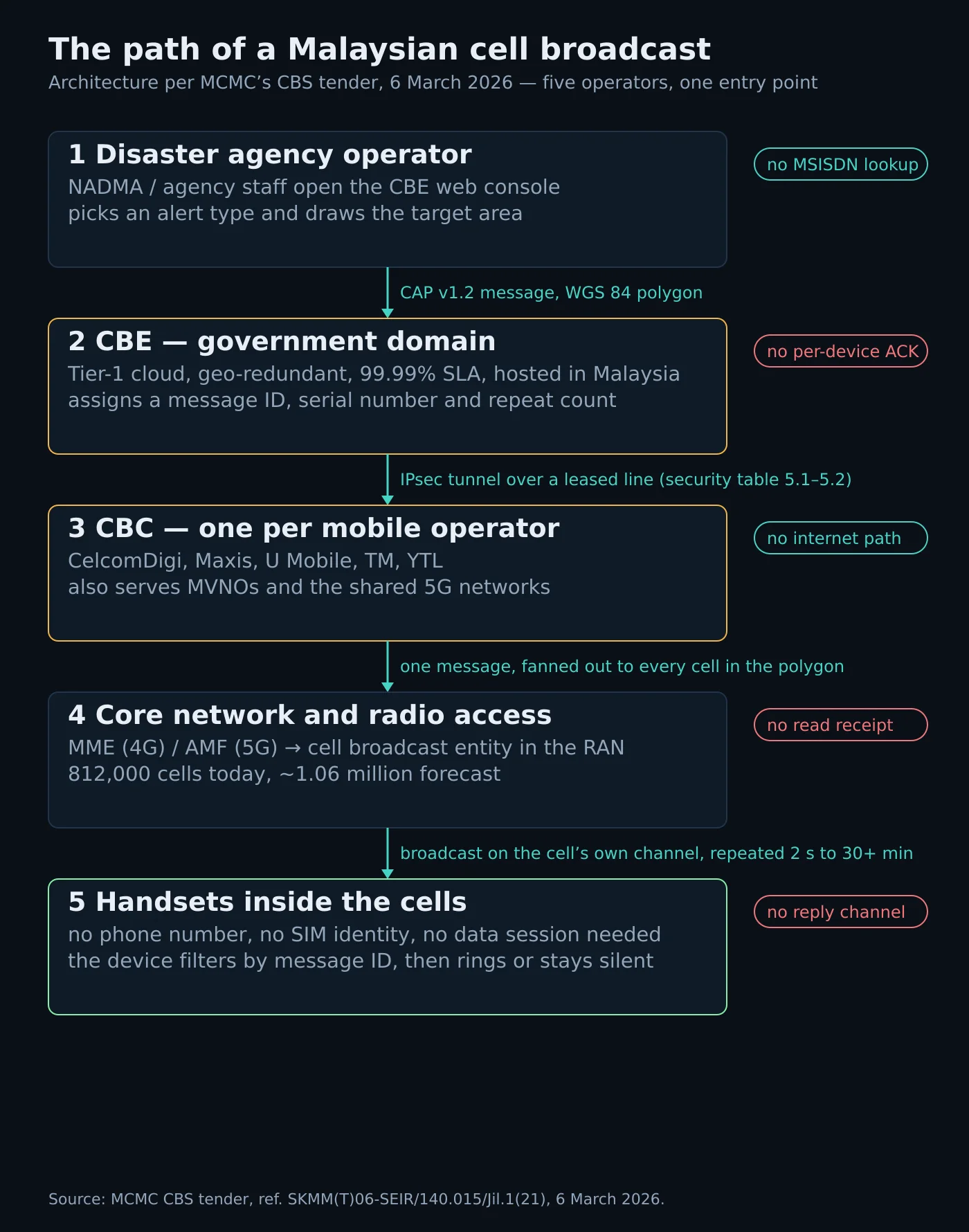
Figure 1: the path of one alert, as specified in the tender. Annotations mark what the design deliberately does not do.
The tender names the two halves explicitly: a centralised Cell Broadcast Entity (CBE) "at government domain" and a distributed Cell Broadcast Centre (CBC) "at MNOs domain", covering five operators — CelcomDigi, Maxis, U Mobile, TM and YTL. Mobile Virtual Network Operators must also receive alerts, and so must the shared radio networks: Digital Nasional Berhad's 5G wholesale network and U Mobile's second 5G network.
The scale is the part worth pausing on. The tender's own dimensioning table lists current cell counts of 370,000, 146,000, 143,000, 38,000, 33,000 for the four-generation networks and 82,000 for the 5G wholesale network — 812,000 cells. Forecast expansion adds 149,100 and 101,000 more. At that size, "did everyone get the message" stops being a question you can answer by asking everyone.
The contract term is ten years: one year of warranty, nine years of support, then the entire system — hardware, software, licences, cloud storage, documentation — is handed to a designated government agency. The CBE must sit on a Tier-1 cloud with geo-redundancy and a 99.99% SLA, and all applications, virtual machines and data must be hosted in Malaysia.
Why a broadcast cannot report who heard it
This is the design choice that everything else follows from.
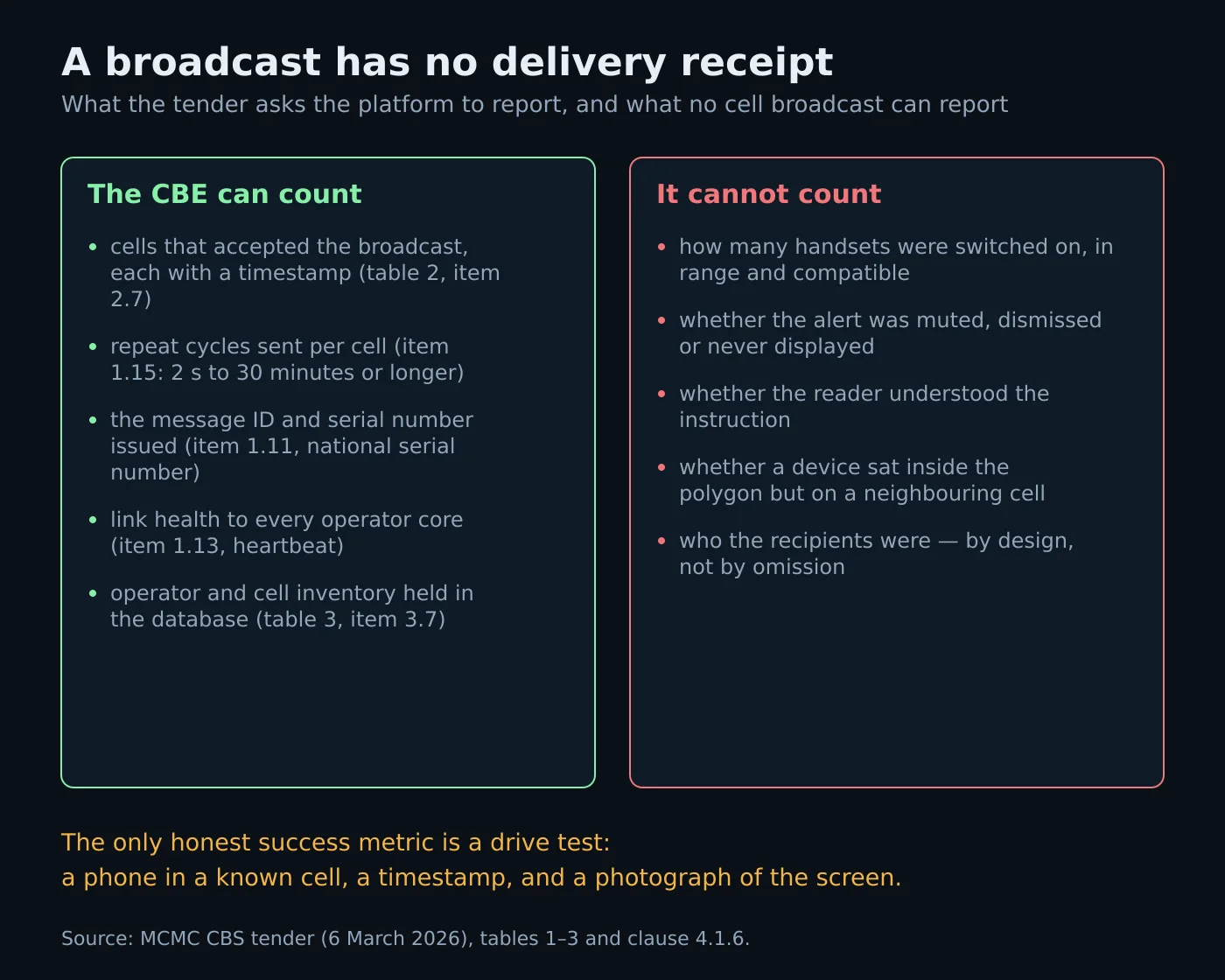
Figure 2: the measurement gap. The platform can prove the network accepted the message; it cannot prove a person saw it.
The tender asks the CBE to "indicate the number of successful broadcasted cells with accurate time stamp". That is the whole success signal. There is no per-device acknowledgement anywhere in the specification, because a broadcast has no return path — the phone is not addressed, so there is nothing to address a receipt to.
The substitute for a receipt is repetition. Table 1 requires a configurable repetition rate "ranging from 2 seconds to over 30 minutes or longer", and a national serial number so a device can tell a new alert from a repeat of one it already showed. Repetition is a probability strategy: send the message often enough that a handset which was in a tunnel, or briefly out of coverage, catches a later cycle. It is not proof of delivery, and no amount of repeating turns it into proof.
Two consequences follow, and both matter for how the 19 November result should be read:
- "Success" will be a network statement. Cells that accepted the broadcast is a real, auditable number. It is also a statement about towers, not about people.
- A device-level figure needs a method. If anyone publishes a percentage of handsets reached, the first question is how it was measured: a drive test with known positions, operator-side attach counts, or an estimate. The tender does not ask for the third and cannot produce the first two by itself.
The message-ID table is where the siren question is decided
The single most useful page in the tender is the message-ID mapping, because it converts "will my phone scream" from a rumour into a lookup.
| Alert level | Mandatory-to-display ID | Optional-to-display ID | Ringtone | Enabled by default | User opt-in / opt-out |
|---|---|---|---|---|---|
| National alerts | 4370 | 4383 | Standard CMAS tone | Not visible in UI | No |
| Extreme emergency | 4371 | 4384 | Standard CMAS tone | Yes | Yes |
| Severe | 4373 | 4386 | Standard CMAS tone | Yes | Yes |
| Active shooter | 4374 | 4387 | Silent | Yes | Yes |
| Amber (child abduction / missing person) | 4379 | 4392 | Standard CMAS tone | Yes | Yes |
| Testing | 4380 | 4393 | Standard CMAS tone | No | Yes |
| Exercise | 4381 | 4394 | Standard CMAS tone | Yes | Yes |
| All clear | 4396 | 4397 | Standard CMAS tone | Yes | Yes |
Table: Malaysia's CBS message-ID mapping, reproduced from tender section 4.1.6.
Read the two bottom-left columns of the Testing row, then read the National row.
A test alert is the one category the specification does not enable by default, and the one it explicitly leaves to the user to opt in or out of. A national alert is the opposite: not visible in the device UI at all, with no user opt-out. So the sentence "on 19 November every phone in four states will sound a siren" is not something the specification promises. It is a prediction about device settings, firmware and the message ID the operator chooses — and the tender leaves that last choice to the people running the test.
There is a second detail in the same table that is easy to miss: the active-shooter category is specified as silent, with no tone at all. That is the cleanest evidence that the tone is a per-category policy decision rather than a property of "emergency". A system that can ring for a flood and stay silent for an active shooter is a system where the tone is configured, not inherent.
Why it can ring through silent mode
This part is platform behaviour rather than a Malaysian specification, so treat it as analysis rather than a quoted fact.
The alert tone is not played through the media or notification volume stream. It is produced by the public-warning handler in the device's baseband and operating system, which is why a phone on silent, or with Do Not Disturb on, can still emit the emergency tone: those settings govern apps, and this path does not go through an app.
Both major platforms expose the switch. On iOS the path is Settings → Notifications → Government Alerts; on Android it is usually Settings → Safety & emergency → Wireless Emergency Alerts, with per-category toggles that vary by manufacturer and by country configuration. The tender's "enabled by default" column is precisely the switch those menus control, which is why the Testing row's "No" is the line to remember before 19 November.
What the alert text looks like on the wire
Cell broadcast text is not UTF-8. It travels as packed septets in the GSM 7-bit default alphabet, seven bits per character, so eight characters fit into seven octets. That packing is why a phone with the wrong alphabet mapping shows mojibake instead of an instruction, and why a screenshot is not evidence of what the message actually said.
This decoder is standard-library only and round-trips its own output, so the packed bytes and the decoded string can be checked against each other:
#!/usr/bin/env python3
"""Unpack the GSM 7-bit default alphabet that Cell Broadcast carries."""

BASIC = ("@\u00a3$\u00a5\u00e8\u00e9\u00f9\u00ec\u00f2\u00c7\n\u00d8\u00f8\r\u00c5\u00e5"
         "\u0394_\u03a6\u0393\u039b\u03a9\u03a0\u03a8\u03a3\u0398\u039e\u001b\u00c6\u00e6\u00df\u00c9"
         " !\"#\u00a4%&'()*+,-./0123456789:;<=>?"
         "\u00a1ABCDEFGHIJKLMNOPQRSTUVWXYZ\u00c4\u00d6\u00d1\u00dc\u00a7"
         "\u00bfabcdefghijklmnopqrstuvwxyz\u00e4\u00f6\u00f1\u00fc\u00e0")


def unpack(octets: bytes) -> str:
    """Read septet i from bit i*7 of the octet stream."""
    text, total = [], len(octets) * 8 // 7
    for i in range(total):
        bit, value = i * 7, 0
        idx, shift = bit // 8, bit % 8
        value = octets[idx] >> shift
        if shift > 1 and idx + 1 < len(octets):
            value |= octets[idx + 1] << (8 - shift)
        text.append(BASIC[value & 0x7F])
    return "".join(text).rstrip("@\r")


def pack(text: str) -> bytes:
    """Inverse of unpack(), so the round trip can be asserted."""
    out, acc, bits = bytearray(), 0, 0
    for char in text:
        acc |= BASIC.index(char) << bits
        bits += 7
        while bits >= 8:
            out.append(acc & 0xFF)
            acc, bits = acc >> 8, bits - 8
    if bits:
        out.append(acc & 0xFF)
    return bytes(out)


ALERT = "UJIAN AMARAN 19 NOV - TIADA BENCANA"
wire = pack(ALERT)
assert unpack(wire) == ALERT, "round trip failed"

print(f"alert text : {ALERT} ({len(ALERT)} chars)")
print(f"on the wire: {wire.hex(' ')} ({len(wire)} octets)")
print(f"decoded    : {unpack(wire)}")
print(f"compression: {len(ALERT)} chars in {len(wire)} octets, 7 bits each")
alert text : UJIAN AMARAN 19 NOV - TIADA BENCANA (35 chars)
on the wire: 55 65 32 e8 04 05 9b 41 69 d0 09 8a e5 40 ce a7 15 d4 02 51 93 41 62 10 24 2c 3a 87 41 67 10 (31 octets)
decoded    : UJIAN AMARAN 19 NOV - TIADA BENCANA
compression: 35 chars in 31 octets, 7 bits each
Thirty-five characters in thirty-one octets is the whole trick: no header, no phone number, no session. A CBS payload is short because it has to be — the cell's broadcast channel carries a small block, repeated, not a conversation.
The security model is network-side, and that is the gap
The tender's security table is stricter than most Malaysian procurement documents I have read, and it is worth listing what it actually requires:
- IPsec for the interface between the CBE and each operator's CBC, plus a specified leased line with firewall and capacity detail (5.1, 5.2)
- no backdoor, no malware, no unauthorised functionality, no unauthorised remote access (5.6)
- compliance with the Cyber Security Act 2024 (Act 854) (5.9)
- multifactor authentication on every remote access path (5.12)
- a cloud estate holding ISO/IEC 27001, 27017, 27018, 22301, 27701, TL 9000 and ISO 9001 (5.13)
- penetration testing by an independent third party that is ISO/IEC 27001 certified and licensed by NACSA (5.14)
- audit and operating-system logs shipped into the operators' own log platforms, Splunk named as the example (5.17)
- access management integrated with Active Directory or CyberArk (5.19)
That is a serious control set. It is also entirely invisible to the person holding the phone.
Here is the asymmetry, stated plainly: every one of those controls protects the path between the agency and the tower. None of them gives the recipient a way to verify that the alert on their screen came from that path. There is no signature a user can check, no out-of-band channel to confirm it, and — by design — no way to reply and ask. The trust anchor is the network, and the only evidence available to a member of the public is that the alert arrived through the platform rather than through an app.
Which points at the likelier 19 November attack. If you wanted to frighten Malaysians that week, you would not attack a system with IPsec, NACSA-licensed pentests and ISO 27001 cloud hosting. You would send an SMS or a WhatsApp message saying "MCMC alert: move to higher ground now" with a link — cheap, instant, and indistinguishable from a government message to anyone who has not been told the difference. The same discipline that defeats QR phishing applies: the channel matters more than the wording, and a link is never the alert.
Privacy: what the system does not need to know
A CBS alert is addressed to a cell, not to a subscriber. No phone number is looked up, no IMSI is required for delivery, and no data session is opened. That is a genuine privacy property, not a marketing one: the system cannot leak a recipient list because it never builds one.
The more interesting requirement is device-based geo-fencing (Table 1, item 1.6), where the handset compares its own position against the polygon carried in the message and decides whether to display the alert. That inverts the usual direction of location data: instead of the network telling the phone it is in danger, the phone checks for itself, and the operator does not need to resolve your position to target you.
Two limits belong in the same paragraph. First, a mobile network always knows which cell a device is attached to — that is how mobility works, and it is a property of the network rather than of CBS. Second, the tender does not say which firmware versions support device-based geo-fencing; it asks the supplier to specify the earliest one, which means the answer for your phone is a device question, not a national one.
What to do on 19 November
- Read the message before reacting. A test message should say it is a test. If it does not, treat it as a real alert until an official channel says otherwise.
- Do not forward a screenshot without the time and place. A test alert photographed in Kelantan and reposted without context reads as a real flood warning in Johor.
- Know where the switch is. Settings → Notifications → Government Alerts on iOS; Settings → Safety & emergency → Wireless Emergency Alerts on Android. Leave emergency categories on.
- Treat links as hostile by default. MCMC does not need you to click anything to deliver a cell broadcast. A message with a link is a different channel.
- If you receive one, note the time, the location and the wording. That record is worth more than the siren: it is the only device-side evidence the test will produce.
What the result should be judged on
The tender already lists what the platform must be able to report, so the post-test questions write themselves: how many cells accepted the broadcast, and how quickly after approval; whether the repeat cycles covered the window when people were actually outdoors; whether the polygon matched the flood extent rather than an administrative boundary; which handset models displayed the message, and which displayed it silently; and whether the log trail from CBE to operator is complete enough to reconstruct a single alert end to end.
None of those answers requires naming a single recipient, and all of them are answerable without one. That is the test worth running — and the reason a "90% of phones received it" headline, if it appears, should be read as an estimate until someone publishes the method behind it.
Sources
- Invitation to Register Interest and Submit a Draft Universal Service Plan as a Universal Service Provider — Provisioning of Cell Broadcast System (CBS) for Early Warning System (EWS) in Malaysia — Malaysian Communications and Multimedia Commission
- MCMC testing new disaster warning system on Nov 19: Here's why your phone might sound an alarm — Malay Mail
- MCMC To Test Cell Broadcast Disaster Alert System On 19 November — Lowyat.NET
- Cell Broadcast System in final phase to deliver disaster alerts to phones — New Straits Times
- Sistem amaran bencana guna CBS beroperasi hujung November ini — Malaysia Gazette
- Sistem amaran awal banjir guna teknologi CBS akan dibangunkan NADMA, MCMC — Agensi Pengurusan Bencana Negara (NADMA)
- 3GPP TS 23.041 — Technical realization of Cell Broadcast Service (CBS) — 3GPP
- 3GPP TS 22.268 — Public Warning System (PWS) requirements — 3GPP
- Cyber Security Act 2024 (Act 854) — National Cyber Security Agency (NACSA)
author
Editor & Operator
MrDodgerX (MrDodgerX) is an enterprise geospatial systems engineer in Malaysia and the editor behind hejes.my. He runs the briefing pipeline, curates and edits every draft, verifies each factual claim against primary sources, and presses the publish button — nothing ships without his review. He writes about AI, security and Malaysia's tech scene from a builder's perspective. Professional profile and code: the links below.
sources
fact-check verified · 08 NOV 2026
Source details and access dates
- Invitation to Register Interest and Submit a Draft Universal Service Plan as a Universal Service Provider — Provisioning of Cell Broadcast System (CBS) for Early Warning System (EWS) in MalaysiaMalaysian Communications and Multimedia Commission · accessed 08 NOV 2026
- MCMC testing new disaster warning system on Nov 19: Here's why your phone might sound an alarmMalay Mail · accessed 08 NOV 2026
- MCMC To Test Cell Broadcast Disaster Alert System On 19 NovemberLowyat.NET · accessed 08 NOV 2026
- Cell Broadcast System in final phase to deliver disaster alerts to phonesNew Straits Times · accessed 08 NOV 2026
- Sistem amaran bencana guna CBS beroperasi hujung November iniMalaysia Gazette · accessed 08 NOV 2026
- Sistem amaran awal banjir guna teknologi CBS akan dibangunkan NADMA, MCMCAgensi Pengurusan Bencana Negara (NADMA) · accessed 08 NOV 2026
- 3GPP TS 23.041 — Technical realization of Cell Broadcast Service (CBS)3GPP · accessed 08 NOV 2026
- 3GPP TS 22.268 — Public Warning System (PWS) requirements3GPP · accessed 08 NOV 2026
- Cyber Security Act 2024 (Act 854)National Cyber Security Agency (NACSA) · accessed 08 NOV 2026
related

Malaysia's Courier Boom Is a Margin Problem
Five million parcels a day sounds like growth. Malaysia's own data shows volume up 29% and courier headcount down 12% — and the margin question nobody asked.

Malaysia's Data Centre Gate Is a Water Margin
Malaysia will not approve data centres in states without spare water. The real test is a reserve margin percentage, and it changes the maths per site.
The 30-Day Form Behind Malaysia's AI Seizures
Customs seized RM49.5M of AI servers at KLIA. The offence was a missing 30-day form, and the directive's real gate is a Category 4 entry few read.
join the feed
one fresh insight per week. no spam, ever.
weekly digest. unsubscribe anytime.