
What was actually hacked in Malaysia, 25 Oct – 8 Nov 2026
Three confirmed incidents, seven unverified ransomware claims, and one SME site still serving its defacement page 14 days later. Here is what really happened.
The past two weeks produced a repeating pattern: a screenshot of a bank page replaced with a black message, then a wave of claims that "Malaysia got hacked". Some of it is true. Most of it is not.
This report separates three things that keep getting mixed together: confirmed incidents (visual evidence or an official statement exists), claims (a group says it did something, nobody has verified it), and things that are not intrusions at all even though they sound like one.
Everything was checked on 8 November 2026. Every figure below is linked to its evidence at the end.
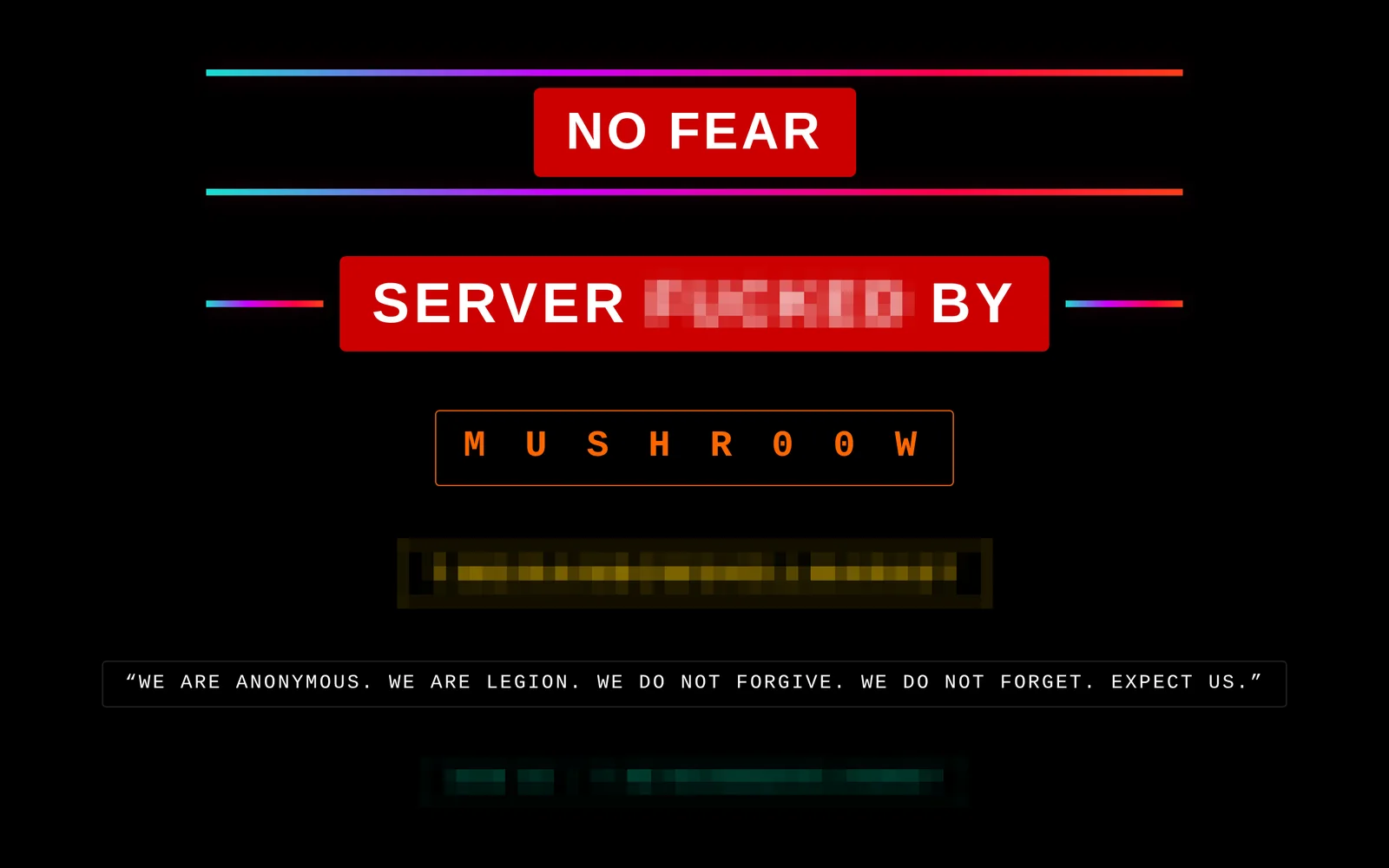
What a defacement looks like: tshirtnuniform.com.my on 8 November 2026 — fourteen days after it was replaced. The operator's name and contact links are obscured.
Three confirmed incidents
Only three things in this window can be verified from primary evidence: two .my SME sites that were defaced, and Bank Rakyat's banking pages.
1. tshirtnuniform.com.my — still defaced 14 days later
On 25 October the site was replaced with an attacker page. The archive record shows server IP 103.8.25.110 (Subang Jaya), Nginx as the web server, and the signature of actor Mushr00w — a name with 94 defacement reports in the public archive.
The defacement is not the interesting part. What happened next is: on 8 November, the page was still serving the attacker's message. Fourteen days. This was not a sophisticated intrusion — it is an index.html nobody replaced, on a site nobody was watching.
2. eshopmcl.com.my — recovered within hours
On 4 November the MCL Distributors storefront suffered the same treatment. Server IP 110.4.45.52 (Kuala Lumpur), LiteSpeed, actor fientix — a name with 1,436 reports.
The difference: this one recovered. By 8 November it was serving "E-SHOP – MCL Distributors" again. No public statement, no customer notice, but the recovery itself is evidence that somebody noticed and acted.
3. Bank Rakyat — banking pages, 6 November
On the night of 6 November, bankrakyat.com.my and the iRakyat online banking pages displayed "MARLANWG IS HERE". The bank took the sites down. Local media reported the disruption, and the National Security Council said it was examining a "hybrid security threat".
This is the only incident in the window involving a large institution, and it is also the one with the most speculation attached.
What the bank says, what the attacker says
Two contradictory narratives exist at once. Neither has met the other in the middle.
| Claim | Source | Status |
|---|---|---|
| iRakyat banking pages were defaced on 6 Nov | Screenshots, media reports, bank statement | Confirmed |
| The bank took the sites down temporarily | Bernama, bank statement | Confirmed |
| The cause was a third-party vendor issue | Bank Rakyat statement | Confirmed as a bank statement, not as a technical explanation |
| No customer data was stolen | Communications minister, bank statement | Confirmed as an official statement, no independent audit published |
| The attacker had internal access to systems | marlanwg's social media claim | Unverified |
| Customer data is being sold | marlanwg's claim | Unverified, no sample data published |
The gap between the fourth and fifth rows is the whole story. "Vendor issue" and "internal access" could be two descriptions of one event — or two different events. Without published forensics, nobody outside the bank can choose.
What we can do: stop repeating claims as fact, and stop treating a denial as proof.
How a defacement actually happens
A defacement is not a sophisticated intrusion. It is usually the same five steps, and only the last one separates a minor incident from one that runs for two weeks.
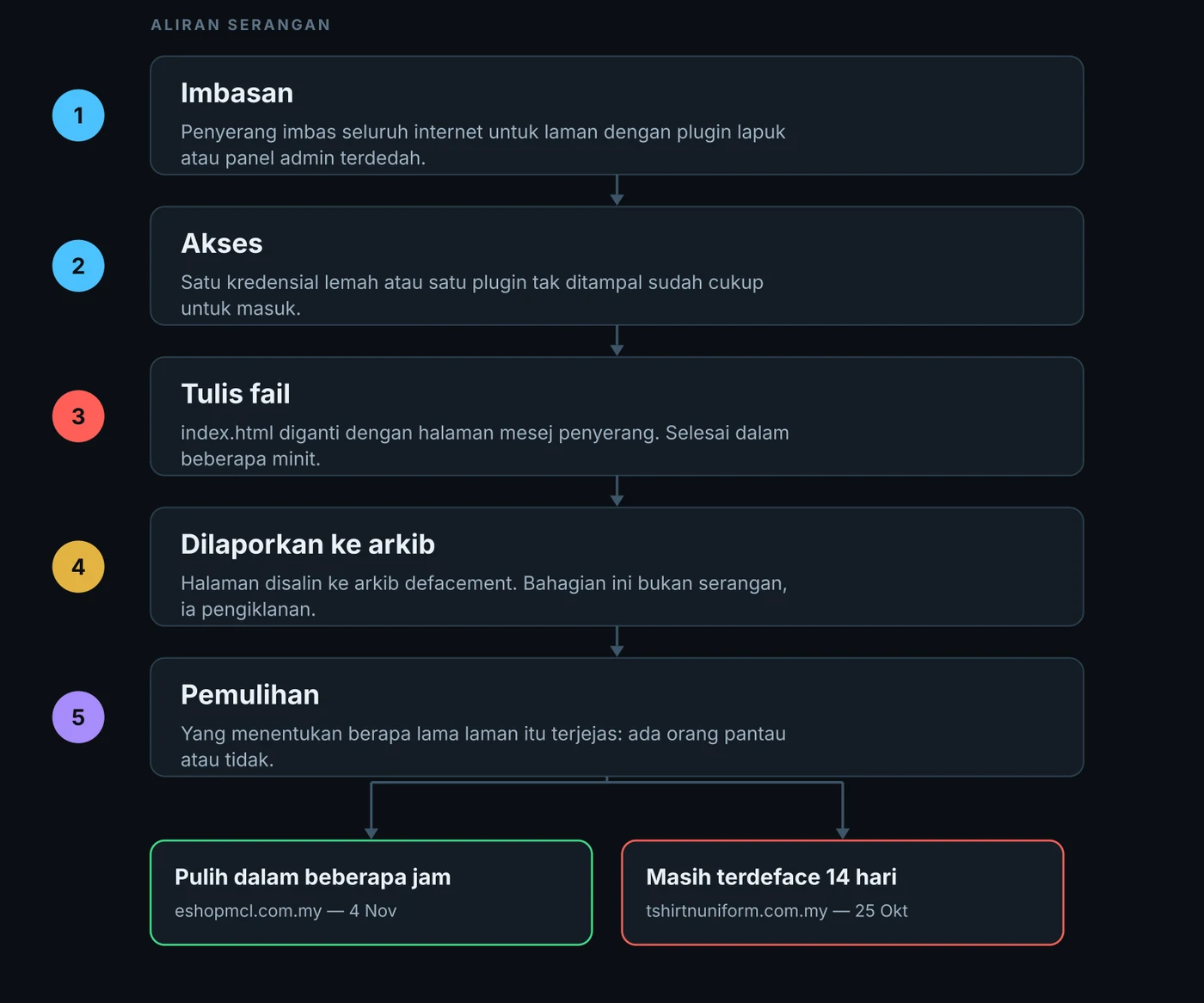
Steps 1–3 take minutes. Step 4 is publicity, not intrusion. Step 5 decides how long the site stays broken — and it depends entirely on whether anyone is watching.
What is not a defacement, even though it sounds like one
Three other things from the same window keep getting folded into the "Malaysia got hacked" list:
- The LED screen in Kluang, 30 October. A digital billboard displayed adult content; no website was defaced. The group that claimed it described the act as a statement rather than an intrusion into a target system. It is a physical-digital security incident, not web defacement.
- Malaysia Airlines, 30 October. The airline issued a statement about an incident at a third-party technology provider (Amadeus). That is vendor exposure, not an intrusion into Malaysia Airlines' own site.
- Banking app outages, 6–8 November. Several banks reported service disruption. None confirmed a cyberattack as the cause. Regional coverage bundled them with the Bank Rakyat defacement because they happened at the same time — that is timing correlation, not evidence of cause.
Seven ransomware claims, all unverified
Between 25 October and 2 November, seven Malaysian entities appeared on ransomware leak sites. These are attacker claims, not confirmations. None of the organisations has confirmed an intrusion, and no data sample has been independently examined.
| Date | Organisation | Group | Sector |
|---|---|---|---|
| 25 Oct | Mah Sing Group (mahsing.com.my) | Scarlettgroup | Property |
| 26 Oct | MISC Group | Rhysida | Shipping and energy |
| 26 Oct | Antah HealthCare Group | crypto24 | Healthcare |
| 30 Oct | INTI International University & Colleges | Rhysida | Education |
| 31 Oct | Digital Triumph | N0n | Technology |
| 2 Nov | Astino Berhad | qilin | Manufacturing |
| 2 Nov | MARDEC Berhad | Orova | Commodities |
One day before this window, on 24 October, Main Place Mall (mainplace.com.my) was also listed by the krybit group. It falls outside the period but matters as context: Malaysia's listing rate did not spike on 6 November — it ran all month.
One thing to understand about leak sites: they are a pressure tool, not a forensic record. Ransomware groups list victims to force payment. Sometimes the data is real. Sometimes it was stolen from a vendor rather than from the company named. Sometimes it does not exist at all. Without a sample, we cannot tell which.
Setel: a RM637,500 fine, not an intrusion
The "Setel got hacked" claim spread after a headline reading "Setel Fined By BNM For Sanctions Database Breach". The word breach there means a regulatory breach, not a system being penetrated.
| What spread | Reality | Classification |
|---|---|---|
| "Setel got hacked" | No defacement record, no ransomware listing, no incident on the official status page | No evidence |
| "Setel Fined By BNM For Sanctions Database Breach" | Setel failed to screen its full customer database against the sanctions list and failed to ensure true matches. RM637,500 penalty imposed 15 April 2026, paid 6 May, announced 26 August | Compliance |
| "Setel data breach report" on a third-party aggregator | Domain flagged as having credentials in infostealer logs. No record count, no date, no victim notice | Unverified |
The fine is serious — the largest compliance penalty BNM announced this year for a case of this kind. But it is not evidence that anyone breached Setel's systems. Two different things, and conflating them weakens both.
Who is behind these incidents
| Actor | Footprint | Type | Linked to |
|---|---|---|---|
| Mushr00w | 94 reports | Defacement | tshirtnuniform.com.my |
| fientix | 1,436 reports | Defacement | eshopmcl.com.my |
| marlanwg | New name | Defacement and exploitation claims | Bank Rakyat, alleged Customs 0-day |
| Rhysida | Ransomware-as-a-service | Ransomware | MISC Group, INTI |
| qilin | Ransomware-as-a-service | Ransomware | Astino Berhad |
| Scarlettgroup, krybit, N0n, Orova, crypto24 | Small groups | Ransomware | Mah Sing, Main Place, Digital Triumph, MARDEC, Antah |
The first two are generic defacers: they do not target Malaysia specifically. They scan the internet for unpatched servers and replace whatever page they find. Malaysia appears in their lists because Malaysia has a lot of unmaintained sites, not because it was chosen.
marlanwg is different. It appeared with a name that does not exist in public records, claimed a financial institution as a target, and — per a VECERT warning on 21 October — offered a 0-day for Malaysian Customs systems. Whether it is a new actor or a new name for an old one, there is no public evidence.
Map: where this actually happened
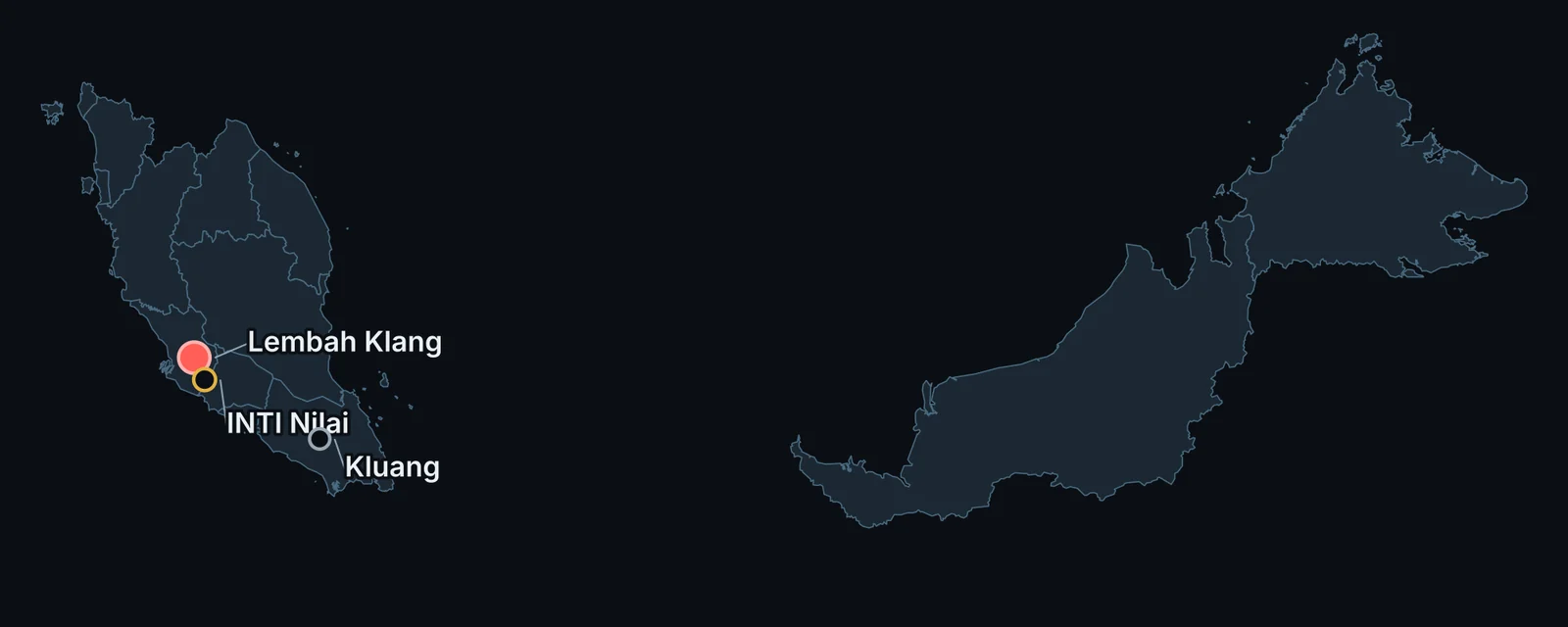
Seven of the nine referenced locations sit in one Klang Valley cluster — which is exactly why a national map cannot separate them. Two fall outside it: INTI in Nilai, and the LED screen in Kluang.
| Marker | Location | What happened |
|---|---|---|
| ● red | Klang Valley | Two confirmed defacements, one banking page, four ransomware claims, one location checked and found clear |
| ○ amber | INTI Nilai | Rhysida ransomware claim, 30 Oct — unverified |
| ○ grey | Kluang, Johor | LED screen displayed adult content, 30 Oct — not a website |
The map makes one point about scale: this is not "Malaysia got hacked". It is concentrated in one region, against different kinds of targets, by actors with no connection to each other.
Repeating patterns
Four things show up in all three confirmed incidents, and in most of the claims:
- The targets were unmaintained sites, not defended systems. Both SME sites ran Nginx and LiteSpeed — ordinary configurations. This class of defacement almost always starts with an unpatched component or weak credentials, not with an advanced attack.
- Recovery took longer than the intrusion. One site recovered in hours; another was still defaced two weeks later. The difference was not technology — it was whether anyone was watching.
- Claims moved faster than verification. Within 24 hours of Bank Rakyat, at least three different claims circulated as fact, including a data-for-sale claim published without a single sample.
- Different groups, different motives, merged into one story. Defacement for reputation, ransomware for money, and billboard hijacking for attention are three different crimes with three different offender profiles.
What to do about it
For small and medium site owners — the group most exposed in this data:
- Check that your site is still your site. A weekly visual check takes 30 seconds and would have caught a case like tshirtnuniform.com.my before it turned two weeks old.
- Know who can write to the web directory. Defacement means someone successfully wrote a file. Shared or stale FTP accounts and admin panels are the most common vector.
- Set up free external monitoring. An uptime service that checks content, not just HTTP status, catches a swapped page.
- Keep backups you can restore in minutes, not days. Recovery time is the difference between eshopmcl.com.my and tshirtnuniform.com.my.
For a static site, the cheapest monitoring is a content fingerprint. Store it once, compare it daily:
# baseline once, then compare daily (cron 07:00)
curl -sL https://your-site.com.my/ | sha256sum | cut -d' ' -f1 > ~/.site-baseline

# a changed hash means someone replaced the page
[ "$(curl -sL https://your-site.com.my/ | sha256sum | cut -d' ' -f1)" = "$(cat ~/.site-baseline)" ] || echo "CHANGED — check now"
It does not work on pages whose content changes on every load (prices, stock, ads). For those, check the elements that should never change — the title, the phone number, the address — rather than the whole page.
For individuals:
- Do not share screenshots without a date and a URL. Almost every misunderstanding in this window started with a screenshot stripped of context.
- Treat aggregator "data breach reports" as leads, not evidence. An infostealer log means someone's credentials were stolen at some point — not that the company was breached.
- For financial accounts, an OTP you did not request is a signal, not an annoyance. It means someone is trying.
Limits of this report
I have no access to any of the organisations' systems. Everything above comes from three sources: public defacement archives (hack-db.org mirror records), ransomware leak-site listings, and media reports plus official statements.
Three limits worth stating:
- Defacement archives only record what attackers report. Sites defaced without a report appear nowhere. "3 incidents" means "3 that can be verified", not "3 that happened".
- None of the ransomware claims is confirmed. They are listed as claims, with dates and group names, so they can be checked later.
- No forensics have been published by Bank Rakyat. The "vendor issue" explanation is a statement, not a technical report. It can be true and still be incomplete.
Glossary
| Term | Meaning |
|---|---|
| Defacement | A site's page replaced with an attacker's message. Usually not data theft — digital vandalism |
| Mirror | A copy of the defaced page stored on the attacker's server or an archive, as "proof" |
| Leak site | The public site where a ransomware group lists victims who refuse to pay |
| Ransomware-as-a-service | A model where ransomware developers rent software to "affiliates" who run attacks |
| Exfiltration | Moving data out of a target system before encryption or threat |
| Infostealer log | Credentials stolen by malware from a user's browser. Often years old |
| TFS | Targeted Financial Sanctions — the list of individuals and entities Malaysians are barred from dealing with |
| ATO | Account takeover — an account seized via stolen credentials, intercepted OTP, or fraud |
| 0-day | A flaw that is unpatched and unknown to the software vendor |
FAQ
Was Bank Rakyat actually hacked? The banking pages were defaced — that is confirmed. The claim that internal systems were breached and customer data stolen is unverified. The bank and the government deny data was stolen; no independent evidence has been published either way.
Why is this list so short? Because defacement archives only keep the cases attackers report themselves. A small site defaced without a report appears in no archive. The real number is higher; the verifiable number is lower.
Is Malaysia specifically targeted? For defacement, no. Mushr00w and fientix scan the whole internet. Malaysia shows up because of the volume of unmaintained sites, not because it was chosen. Ransomware is different — groups like Rhysida target specific industries across countries.
If my site is affected, what is step one? Take it down (do not leave the attacker's message serving), rotate every administrative credential, review access logs to establish when and how the file was written, then restore from a backup you know is clean. Do not restore onto the same server without knowing the entry point.
Can I trust this report? Every row is backed by a link in the sources section below, with an access date. Claims are separated from confirmations throughout. If you find an error, it can be corrected — that is why every figure carries a reference.
author
Editor & Operator
MrDodgerX (MrDodgerX) is an enterprise geospatial systems engineer in Malaysia and the editor behind hejes.my. He runs the briefing pipeline, curates and edits every draft, verifies each factual claim against primary sources, and presses the publish button — nothing ships without his review. He writes about AI, security and Malaysia's tech scene from a builder's perspective. Professional profile and code: the links below.
sources
fact-check verified · 08 NOV 2026
Source details and access dates
- Defacement mirror record #152521 (25 Oct 2026)hack-db.org · accessed 08 NOV 2026
- Defacement mirror record #152705 (4 Nov 2026)hack-db.org · accessed 08 NOV 2026
- Bank Rakyat takes down sites after suspected cyber attackLowyat.NET · accessed 08 NOV 2026
- Bank Rakyat under suspected cyberattack by MarlanwgPokde.Net · accessed 08 NOV 2026
- Bank Rakyat websites defaced by MarlanwgCyberSecurity ASEAN · accessed 08 NOV 2026
- Bank Rakyat website experiences temporary disruptionBernama · accessed 08 NOV 2026
- Laman web bank digodam, MKN teliti ancaman keselamatan hibridRTM · accessed 08 NOV 2026
- Malaysia's cybersecurity situation remains under controlNew Straits Times · accessed 08 NOV 2026
- Banking system secure, says Fahmi after Bank Rakyat hackFree Malaysia Today · accessed 08 NOV 2026
- Service disruptions at three Malaysian banksLianhe Zaobao · accessed 08 NOV 2026
- Administrative Monetary Penalty on Setel VenturesBank Negara Malaysia · accessed 08 NOV 2026
- Statement on BNM announcementPETRONAS Dagangan Berhad · accessed 08 NOV 2026
- Setel says regulatory gaps fixed after RM637,500 penaltyMalay Mail · accessed 08 NOV 2026
- No customer impact from Setel BNM fineFintech News Malaysia · accessed 08 NOV 2026
- Setel Status — incident historySetel · accessed 08 NOV 2026
- Govt websites still getting hijacked by online casinosMalaysiakini · accessed 08 NOV 2026
- Govt websites hacked, says NacsaThe Star · accessed 08 NOV 2026
- Actor profile: Mushr00w (94 reports)hack-db.org · accessed 08 NOV 2026
- Actor profile: fientix (1,436 reports)hack-db.org · accessed 08 NOV 2026
- Malaysia Web Defacement Observatory — aggregate statisticsMalaysia Web Defacement Observatory · accessed 08 NOV 2026
- Malaysia — ransomware and CVEs by countryHackerFeeds · accessed 08 NOV 2026
- Warning: 0-day offer for Malaysian Customs by marlanwgVECERT · accessed 08 NOV 2026
- Statement on third-party technology provider incidentMalaysia Airlines · accessed 08 NOV 2026
- Leakers group hijacks digital billboardsSays.com · accessed 08 NOV 2026
related
Your Phone May Scream on 19 November. No Proof You Heard It
Malaysia's alert test will be judged on cells reached, not handsets. The tender behind it says so — and its message-ID table decides whether your phone rings.
Bank Rakyat's Defaced Pages Said 'Security Assessment'. The $2,000 Listing Was Already Up.
Bank Rakyat's pages were defaced with a note titled 'Security Assessment'. An hour before, the same handle was selling server access for $2,000.

PHP2Shell: NACSA Urges Immediate PHP Patching
NACSA wants internet-facing PHP patched now. Here is how to verify the version actually serving your site, and why the obvious workaround is its own trap.
join the feed
one fresh insight per week. no spam, ever.
weekly digest. unsubscribe anytime.